JavaNIO寫大文件對比(win7和mac)
測試說明
創新互聯建站服務項目包括寧蒗網站建設、寧蒗網站制作、寧蒗網頁制作以及寧蒗網絡營銷策劃等。多年來,我們專注于互聯網行業,利用自身積累的技術優勢、行業經驗、深度合作伙伴關系等,向廣大中小型企業、政府機構等提供互聯網行業的解決方案,寧蒗網站推廣取得了明顯的社會效益與經濟效益。目前,我們服務的客戶以成都為中心已經輻射到寧蒗省份的部分城市,未來相信會繼續擴大服務區域并繼續獲得客戶的支持與信任!
寫2G文件,分批次寫入,每批次寫入128MB;
分別在Win7系統(3G內存,雙核,32位,T系列處理器)和MacOS系統(8G內存,四核,64位,i7系列處理器)下運行測試。理論上跟硬盤類型和配置也有關系,這里不再貼出了。
測試代碼
package rwbigfile;

import java.io.ByteArrayInputStream;
import java.io.File;
import java.io.IOException;
import java.io.RandomAccessFile;
import java.lang.reflect.Method;
import java.nio.ByteBuffer;
import java.nio.MappedByteBuffer;
import java.nio.channels.Channels;
import java.nio.channels.FileChannel;
import java.nio.channels.FileChannel.MapMode;
import java.nio.channels.ReadableByteChannel;
import java.security.AccessController;
import java.security.PrivilegedAction;

import util.StopWatch;

/**
 * NIO寫大文件比較
 * @author Will
 *
 */
public class WriteBigFileComparison {

	// data chunk be written per time
	private static final int DATA_CHUNK = 128 * 1024 * 1024;

	// total data size is 2G
	private static final long LEN = 2L * 1024 * 1024 * 1024L;


	public static void writeWithFileChannel() throws IOException {
		File file = new File("e:/test/fc.dat");
		if (file.exists()) {
			file.delete();
		}

		RandomAccessFile raf = new RandomAccessFile(file, "rw");
		FileChannel fileChannel = raf.getChannel();

		byte[] data = null;
		long len = LEN;
		ByteBuffer buf = ByteBuffer.allocate(DATA_CHUNK);
		int dataChunk = DATA_CHUNK / (1024 * 1024);
		while (len >= DATA_CHUNK) {
			System.out.println("write a data chunk: " + dataChunk + "MB");

			buf.clear(); // clear for re-write
			data = new byte[DATA_CHUNK];
			for (int i = 0; i < DATA_CHUNK; i++) {
				buf.put(data[i]);
			}

			data = null;

			buf.flip(); // switches a Buffer from writing mode to reading mode
			fileChannel.write(buf);
			fileChannel.force(true);

			len -= DATA_CHUNK;
		}

		if (len > 0) {
			System.out.println("write rest data chunk: " + len + "B");
			buf = ByteBuffer.allocateDirect((int) len);
			data = new byte[(int) len];
			for (int i = 0; i < len; i++) {
				buf.put(data[i]);
			}

			buf.flip(); // switches a Buffer from writing mode to reading mode, position to 0, limit not changed
			fileChannel.write(buf);
			fileChannel.force(true);
			data = null;
		}

		fileChannel.close();
		raf.close();
	}

	/**
	 * write big file with MappedByteBuffer
	 * @throws IOException
	 */
	public static void writeWithMappedByteBuffer() throws IOException {
		File file = new File("e:/test/mb.dat");
		if (file.exists()) {
			file.delete();
		}

		RandomAccessFile raf = new RandomAccessFile(file, "rw");
		FileChannel fileChannel = raf.getChannel();
		int pos = 0;
		MappedByteBuffer mbb = null;
		byte[] data = null;
		long len = LEN;
		int dataChunk = DATA_CHUNK / (1024 * 1024);
		while (len >= DATA_CHUNK) {
			System.out.println("write a data chunk: " + dataChunk + "MB");

			mbb = fileChannel.map(MapMode.READ_WRITE, pos, DATA_CHUNK);
			data = new byte[DATA_CHUNK];
			mbb.put(data);

			data = null;

			len -= DATA_CHUNK;
			pos += DATA_CHUNK;
		}

		if (len > 0) {
			System.out.println("write rest data chunk: " + len + "B");

			mbb = fileChannel.map(MapMode.READ_WRITE, pos, len);
			data = new byte[(int) len];
			mbb.put(data);
		}

		data = null;
		unmap(mbb);  // release MappedByteBuffer
		fileChannel.close();
	}

	public static void writeWithTransferTo() throws IOException {
		File file = new File("e:/test/transfer.dat");
		if (file.exists()) {
			file.delete();
		}

		RandomAccessFile raf = new RandomAccessFile(file, "rw");
		FileChannel toFileChannel = raf.getChannel();

		long len = LEN;
		byte[] data = null;
		ByteArrayInputStream bais = null;
		ReadableByteChannel fromByteChannel = null;
		long position = 0;
		int dataChunk = DATA_CHUNK / (1024 * 1024);
		while (len >= DATA_CHUNK) {
			System.out.println("write a data chunk: " + dataChunk + "MB");

			data = new byte[DATA_CHUNK];
			bais = new ByteArrayInputStream(data);
			fromByteChannel = Channels.newChannel(bais);

			long count = DATA_CHUNK;
			toFileChannel.transferFrom(fromByteChannel, position, count);

			data = null;
			position += DATA_CHUNK;
			len -= DATA_CHUNK;
		}

		if (len > 0) {
			System.out.println("write rest data chunk: " + len + "B");

			data = new byte[(int) len];
			bais = new ByteArrayInputStream(data);
			fromByteChannel = Channels.newChannel(bais);

			long count = len;
			toFileChannel.transferFrom(fromByteChannel, position, count);
		}

		data = null;
		toFileChannel.close();
		fromByteChannel.close();
	}

	/**
	 * 在MappedByteBuffer釋放后再對它進行讀操作的話就會引發jvm crash,在并發情況下很容易發生
	 * 正在釋放時另一個線程正開始讀取,于是crash就發生了。所以為了系統穩定性釋放前一般需要檢
	 * 查是否還有線程在讀或寫
	 * @param mappedByteBuffer
	 */
	public static void unmap(final MappedByteBuffer mappedByteBuffer) {
		try {
			if (mappedByteBuffer == null) {
				return;
			}

			mappedByteBuffer.force();
			AccessController.doPrivileged(new PrivilegedAction<Object>() {
				@Override
				@SuppressWarnings("restriction")
				public Object run() {
					try {
						Method getCleanerMethod = mappedByteBuffer.getClass()
								.getMethod("cleaner", new Class[0]);
						getCleanerMethod.setAccessible(true);
						sun.misc.Cleaner cleaner =
								(sun.misc.Cleaner) getCleanerMethod
									.invoke(mappedByteBuffer, new Object[0]);
						cleaner.clean();

					} catch (Exception e) {
						e.printStackTrace();
					}
					System.out.println("clean MappedByteBuffer completed");
					return null;
				}
			});

		} catch (Exception e) {
			e.printStackTrace();
		}
	}

	public static void main(String[] args) throws IOException {
		StopWatch sw = new StopWatch();

		sw.startWithTaskName("write with file channel's write(ByteBuffer)");
		writeWithFileChannel();
		sw.stopAndPrint();

		sw.startWithTaskName("write with file channel's transferTo");
		writeWithTransferTo();
		sw.stopAndPrint();

		sw.startWithTaskName("write with MappedByteBuffer");
		writeWithMappedByteBuffer();
		sw.stopAndPrint();
	}

}
測試結果(Y軸是耗時秒數)
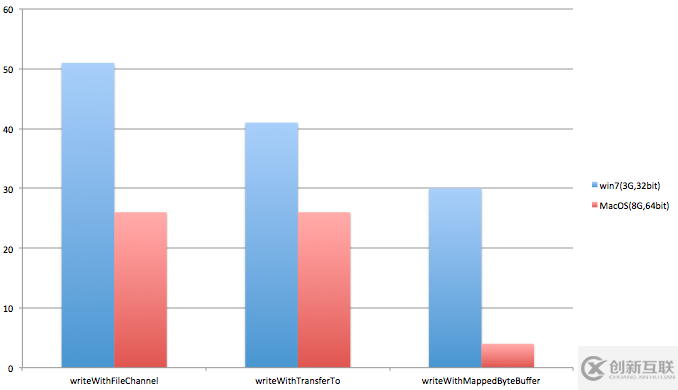
- 顯然writeWithMappedByteBuffer方式性能最好,且在硬件配置較高情況下優勢越加明顯
- 在硬件配置較低情況下,writeWithTransferTo比writeWithFileChannel性能稍好
- 在硬件配置較高情況下,writeWithTransferTo和writeWithFileChannel的性能基本持平
- 此外,注意writeWithMappedByteBuffer方式除了占用JVM堆內存外,還要占用額外的native內存(Direct Byte Buffer內存)
內存映射文件使用經驗
MappedByteBuffer需要占用“雙倍”的內存(對象JVM堆內存和Direct Byte Buffer內存),可以通過-XX:MaxDirectMemorySize參數設置后者最大大小
不要頻繁調用MappedByteBuffer的force()方法,因為這個方法會強制OS刷新內存中的數據到磁盤,從而只能獲得些微的性能提升(相比IO方式),可以用后面的代碼實例進行定時、定量刷新
如果突然斷電或者服務器突然Down,內存映射文件數據可能還沒有寫入磁盤,這時就會丟失一些數據。為了降低這種風險,避免用MappedByteBuffer寫超大文件,可以把大文件分割成幾個小文件,但不能太小(否則將失去性能優勢)
ByteBuffer的rewind()方法將position屬性設回為0,因此可以重新讀取buffer中的數據;limit屬性保持不變,因此可讀取的字節數不變
ByteBuffer的flip()方法將一個Buffer由寫模式切換到讀模式
ByteBuffer的clear()和compact()可以在我們讀完ByteBuffer中的數據后重新切回寫模式。不同的是clear()會將position設置為0,limit設為capacity,換句話說Buffer被清空了,但Buffer內的數據并沒有被清空。如果Buffer中還有未被讀取的數據,那調用clear()之后,這些數據會被“遺忘”,再寫入就會覆蓋這些未讀數據。而調用compcat()之后,這些未被讀取的數據仍然可以保留,因為它將所有還未被讀取的數據拷貝到Buffer的左端,然后設置position為緊隨未讀數據之后,limit被設置為capacity,未讀數據不會被覆蓋
定時、定量刷新內存映射文件到磁盤
import java.io.File;
import java.io.IOException;
import java.io.RandomAccessFile;
import java.nio.MappedByteBuffer;
import java.nio.channels.FileChannel;

public class MappedFile {

	// 文件名
	private String fileName;

	// 文件所在目錄路徑
	private String fileDirPath;

	// 文件對象
	private File file;

	private MappedByteBuffer mappedByteBuffer;
	private FileChannel fileChannel;
	private boolean boundSuccess = false;

	// 文件最大只能為50MB
	private final static long MAX_FILE_SIZE = 1024 * 1024 * 50;

	// 最大的臟數據量512KB,系統必須觸發一次強制刷
	private long MAX_FLUSH_DATA_SIZE = 1024 * 512;

	// 最大的刷間隔,系統必須觸發一次強制刷
	private long MAX_FLUSH_TIME_GAP = 1000;

	// 文件寫入位置
	private long writePosition = 0;

	// 最后一次刷數據的時候
	private long lastFlushTime;

	// 上一次刷的文件位置
	private long lastFlushFilePosition = 0;

	public MappedFile(String fileName, String fileDirPath) {
		super();
		this.fileName = fileName;
		this.fileDirPath = fileDirPath;
		this.file = new File(fileDirPath + "/" + fileName);
		if (!file.exists()) {
			try {
				file.createNewFile();
			} catch (IOException e) {
				e.printStackTrace();
			}
		}

	}

	/**
	 *
	 * 內存映照文件綁定
	 * @return
	 */
	public synchronized boolean boundChannelToByteBuffer() {
		try {
			RandomAccessFile raf = new RandomAccessFile(file, "rw");
			this.fileChannel = raf.getChannel();
		} catch (Exception e) {
			e.printStackTrace();
			this.boundSuccess = false;
			return false;
		}

		try {
			this.mappedByteBuffer = this.fileChannel
					.map(FileChannel.MapMode.READ_WRITE, 0, MAX_FILE_SIZE);
		} catch (IOException e) {
			e.printStackTrace();
			this.boundSuccess = false;
			return false;
		}

		this.boundSuccess = true;
		return true;
	}

	/**
	 * 寫數據:先將之前的文件刪除然后重新
	 * @param data
	 * @return
	 */
	public synchronized boolean writeData(byte[] data) {

		return false;
	}

	/**
	 * 在文件末尾追加數據
	 * @param data
	 * @return
	 * @throws Exception
	 */
	public synchronized boolean appendData(byte[] data) throws Exception {
		if (!boundSuccess) {
			boundChannelToByteBuffer();
		}

		writePosition = writePosition + data.length;
		if (writePosition >= MAX_FILE_SIZE) {  // 如果寫入data會超出文件大小限制,不寫入
			flush();
			writePosition = writePosition - data.length;
			System.out.println("File="
								+ file.toURI().toString()
								+ " is written full.");
			System.out.println("already write data length:"
								+ writePosition
								+ ", max file size=" + MAX_FILE_SIZE);
			return false;
		}

		this.mappedByteBuffer.put(data);

		// 檢查是否需要把內存緩沖刷到磁盤
		if ( (writePosition - lastFlushFilePosition > this.MAX_FLUSH_DATA_SIZE)
			 ||
			 (System.currentTimeMillis() - lastFlushTime > this.MAX_FLUSH_TIME_GAP
			 && writePosition > lastFlushFilePosition) ) {
			flush();  // 刷到磁盤
		}

		return true;
	}

	public synchronized void flush() {
		this.mappedByteBuffer.force();
		this.lastFlushTime = System.currentTimeMillis();
		this.lastFlushFilePosition = writePosition;
	}

	public long getLastFlushTime() {
		return lastFlushTime;
	}

	public String getFileName() {
		return fileName;
	}

	public String getFileDirPath() {
		return fileDirPath;
	}

	public boolean isBundSuccess() {
		return boundSuccess;
	}

	public File getFile() {
		return file;
	}

	public static long getMaxFileSize() {
		return MAX_FILE_SIZE;
	}

	public long getWritePosition() {
		return writePosition;
	}

	public long getLastFlushFilePosition() {
		return lastFlushFilePosition;
	}

	public long getMAX_FLUSH_DATA_SIZE() {
		return MAX_FLUSH_DATA_SIZE;
	}

	public long getMAX_FLUSH_TIME_GAP() {
		return MAX_FLUSH_TIME_GAP;
	}

}
以上就是本文的全部內容,希望對大家的學習有所幫助,也希望大家多多支持創新互聯。
文章標題:JavaNIO寫大文件對比(win7和mac)
網站鏈接:http://www.yijiale78.com/article24/jcshce.html
成都網站建設公司_創新互聯,為您提供Google、網站策劃、網站內鏈、App開發、手機網站建設、品牌網站建設
聲明:本網站發布的內容(圖片、視頻和文字)以用戶投稿、用戶轉載內容為主,如果涉及侵權請盡快告知,我們將會在第一時間刪除。文章觀點不代表本網站立場,如需處理請聯系客服。電話:028-86922220;郵箱:631063699@qq.com。內容未經允許不得轉載,或轉載時需注明來源: 創新互聯

- 免費的軟件開發和開源軟件能不能用 2016-08-16
- 成都e代駕APP軟件開發 2022-06-14
- 成都軟件開發企業定制軟件只是一個開始 2022-05-28
- 成都app軟件開發公司需要做的準備工作 2022-08-04
- APP軟件開發為什么那么貴,具體貴在哪里? 2020-11-13
- 行業軟件開發遇到問題該如何解決 2022-07-18
- 如何讓App軟件開發流程更科學 2022-05-07
- 電商APP軟件開發優勢? 2023-03-25
- 如何登陸網站ftp賬號?ftp賬號是什么意思 2021-05-06
- 手機app軟件開發應該有一個硬性的考核指標 2016-08-23
- 軟件開發和網站開發哪種好?兩者有什么區別? 2022-05-29
- 目前制作APP軟件開發的市場還是很龐大的 2021-06-03